Anthropic’s Major Release for Financial Services
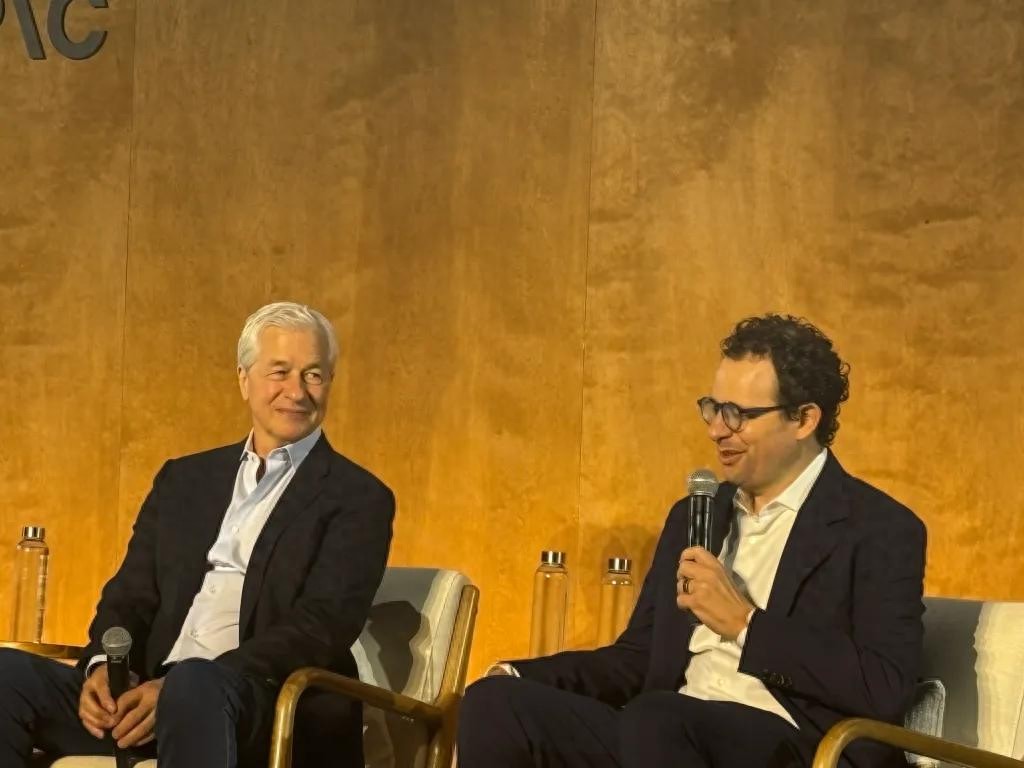
On May 5th, in New York, Anthropic CEO Dario Amodei shared the stage with JPMorgan CEO Jamie Dimon, marking Anthropic’s entry into Wall Street’s core circle.
On the same day, Anthropic announced a suite of AI agents for financial services, featuring 10 deployable workflow reference architectures, Moody’s MCP application (covering 600 million companies), and 8 new data connectors. Excel, PowerPoint, and Word plugins are now available, with an Outlook plugin coming soon.
The 10 financial agent templates cover a complete workflow from roadshow preparation to compliance screening, including tasks such as preparing roadshow materials, briefing clients, updating financial models, conducting industry research, evaluating valuation logic, reconciling ledgers, completing month-end closings, and verifying financial report consistency.
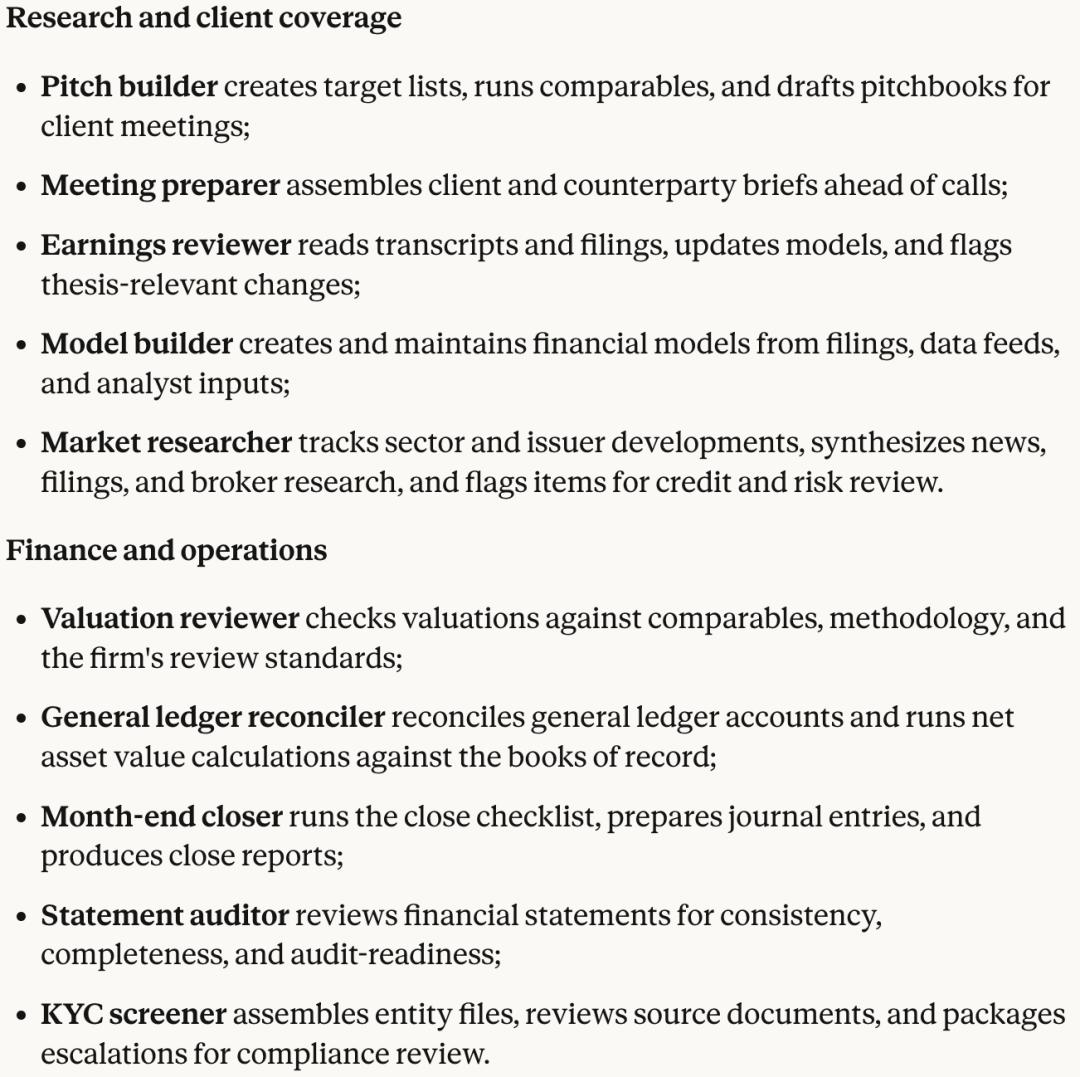
These tasks are core workflows that financial institutions repeat every quarter.
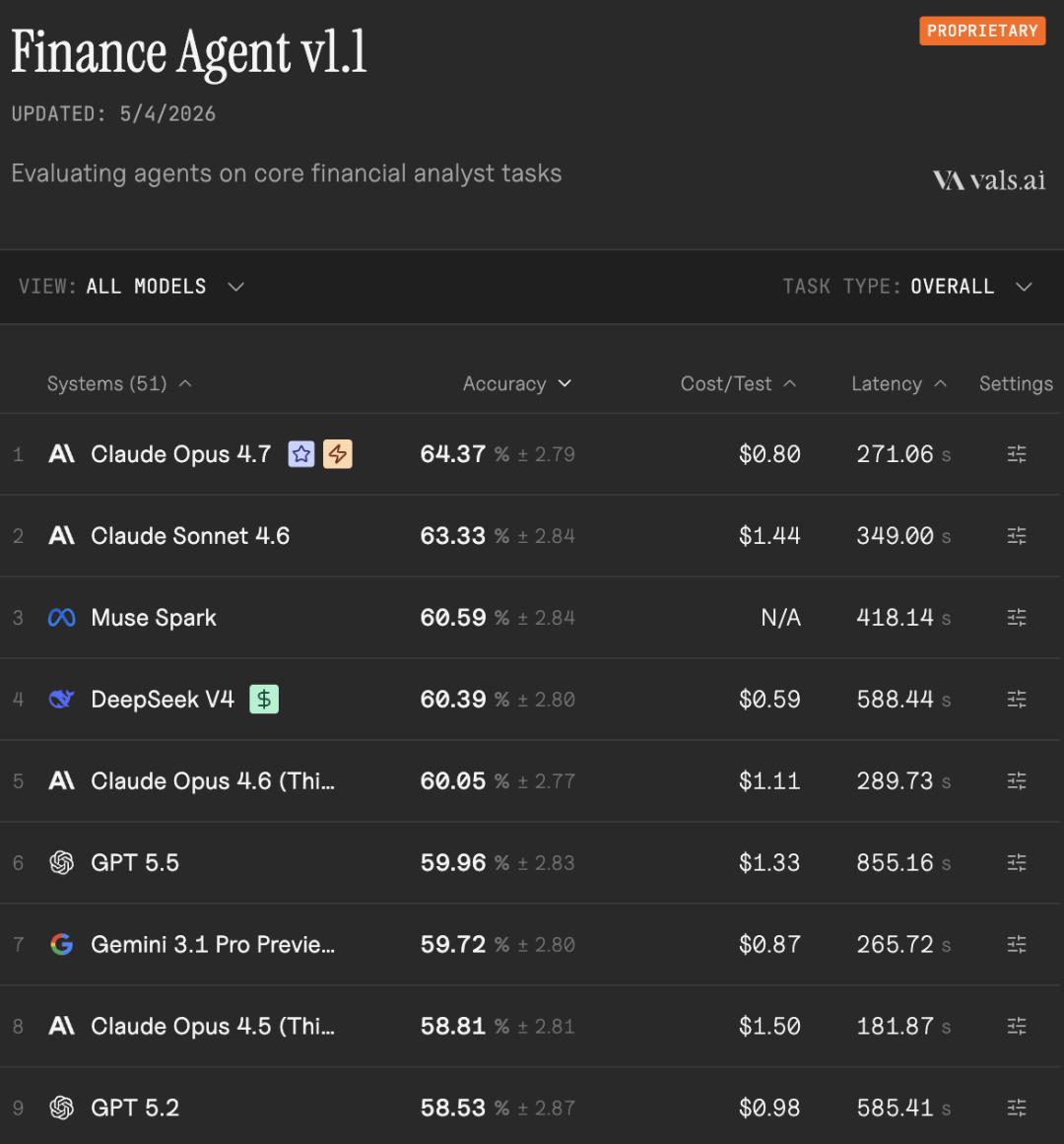
On the same day, Vals AI’s financial benchmark Finance Agent v1.1 ranked Claude Opus 4.7 at the top with an accuracy of 64.37%.
According to Anthropic, finance has become its second-largest source of revenue, following technology, with 40% of its top 50 clients from financial institutions.
Anthropic’s 10 Agent Templates from Front to Back Office
The 10 agents released are not just prompts; Anthropic has broken down each template into three components:
- Skills (task instructions and domain knowledge)
- Connectors (authorization channels for real-time access to external data)
- Subagents (auxiliary models summoned for specific sub-tasks)
For example, the workflow for the roadshow preparation template theoretically involves:
You provide a target client list, and it generates a comparable company table, builds a financial model in Excel, drafts a presentation in PowerPoint, and prepares a cover letter in Outlook for your review.
The entire chain operates without needing you to explain the context mid-process; the context flows automatically between applications, resembling a backend system that never shuts down.
There are two deployment methods:
- As a plugin for Cowork or Claude Code, running alongside analysts at their desks, allowing for human intervention.
- As a managed agent running autonomously on the Claude Platform, capable of handling multi-hour deal closures and overnight reconciliations.
Managed Agents come with capabilities that would typically take engineering teams months to develop: long conversations, granular permissions by tool, a managed credential vault, and a complete audit log retained in the Claude Console.
The combination of 10 templates and two deployment forms means that agent workflows that previously required months of engineering can now be launched in just a few days.
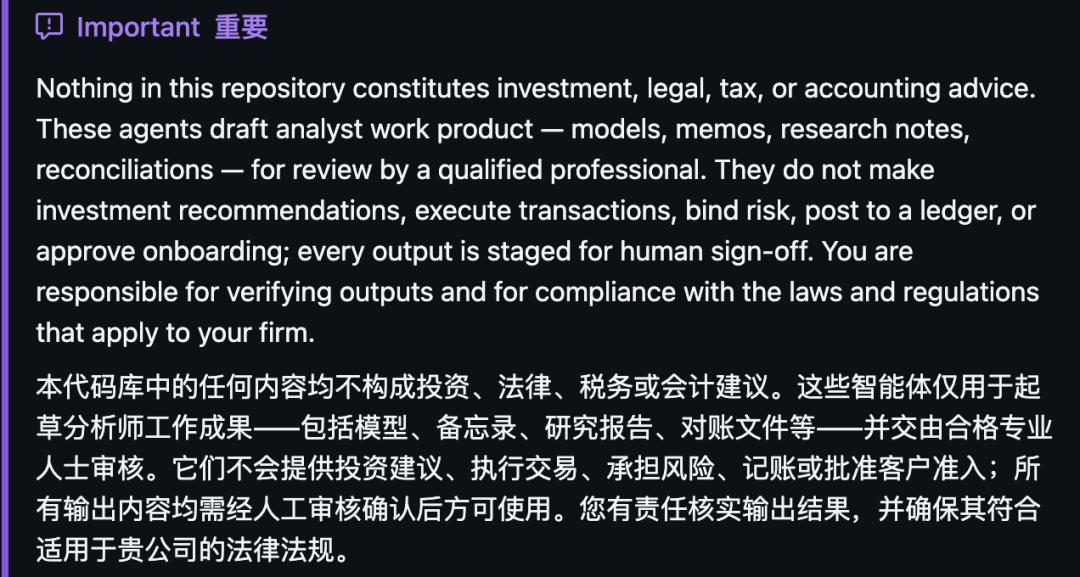
However, Anthropic cautions in its GitHub repository:
These agents do not execute trades, approve client onboarding, process transactions, or provide investment advice. All outputs must be reviewed by professionals before use.
Claude Enhancements in Excel, PowerPoint, and Word
The second focus is on application layer entry: Microsoft 365.
Excel, PowerPoint, and Word add-ins are fully available, with the Outlook add-in coming soon.
Anthropic has defined what Claude can do within each application:
In Excel, Claude can build financial models from regulatory filings and real-time data streams, cross-link workbooks to review formulas, and run sensitivity analyses.
In PowerPoint, Claude drafts decks that automatically update slides when underlying numbers change.
In Word, Claude modifies credit memos according to company templates.
In Outlook, Claude acts as a chief of staff, triaging inboxes, scheduling meetings, and drafting replies in your tone.
Beyond the four applications, the critical aspect is that context automatically transfers between them.
Models built in Excel can move to PowerPoint without needing to re-explain; knowledge and context travel with the task rather than being locked within a single software.
This integration shifts the granularity of financial workflows from “applications” to “tasks.”
Previously, a complete client analysis required calculations in Excel, visuals in PowerPoint, writing in Word, and sending via Outlook, with context needing to be reorganized at each software transition. Now, Claude has seamlessly integrated these four applications into a streamlined process.
Claude Cowork also features a function called Dispatch, allowing analysts to assign tasks to Claude via text or voice from anywhere. Claude continues processing local files while the analyst is away, ready for review upon their return.
The significance of this integration goes beyond functionality.
Microsoft 365 is one of the most common productivity stacks among Wall Street financial institutions. By integrating agents into the Office suite, financial institutions can implement these solutions without waiting for IT teams to undertake extensive migrations; agents enhance existing workstations rather than requiring replacements.
For analysts, the previous method of opening a browser, pasting a prompt, and then copying results back into Excel is becoming obsolete.
Integrating 600 Million Company Data into Claude
The third focus is on data layer entry.
On the same day, Moody’s announced the integration of its credit ratings and compliance data streams into Claude’s working environment via the MCP application.
This data stream encompasses over 600 million public and private company records and 2 billion ownership relationships.
What does this mean?
An AI agent performing credit analysis can theoretically query its credit/risk data, ownership penetration relationships, and compliance-related risk markers, all sourced from the Moody database, without leaving the Claude interface.
The newly added connectors include Dun & Bradstreet, IBISWorld, Third Bridge, and Guidepoint. Earlier, FactSet, PitchBook, LSEG, Morningstar, and S&P Capital IQ were already integrated.
The financial data platform is evolving from a “terminal subscription business” into a tool layer for agents.
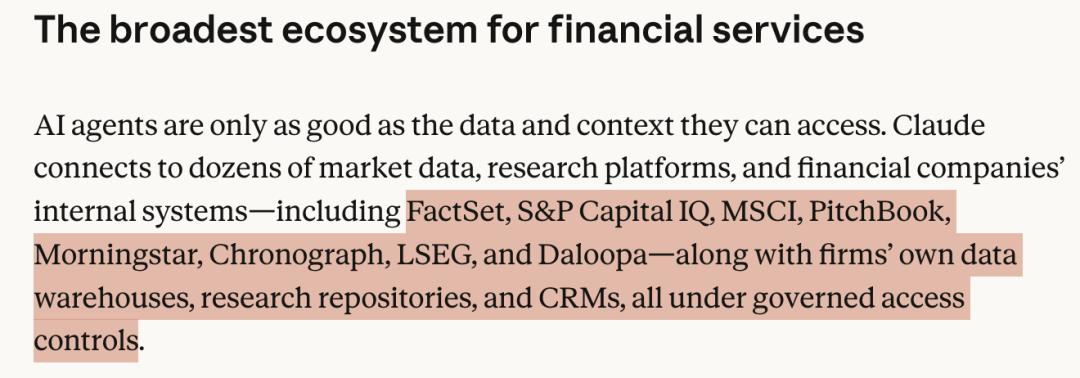
The capabilities of AI agents depend on the data and context they can access. The financial data platforms integrated into the Claude ecosystem include FactSet, PitchBook, LSEG, Morningstar, and the newly added Moody’s and Dun & Bradstreet.
Moody’s MCP app/server is based on the open Model Context Protocol standard and is not exclusively tied to Claude.
Previously, financial data was scattered across dozens of terminals and APIs, each requiring separate logins, permission models, and query syntax. The MCP’s open protocol is consolidating these disparate data layers into a unified agent tool layer. Above the terminal and API layers, a third layer of agent tools is taking shape.
This is the logic Anthropic is betting on: whoever standardizes this layer first will gain access to the next decade’s financial data entry.
Anthropic Enters a Red Ocean
The AI race on Wall Street is no longer an open field.
JPMorgan, Goldman Sachs, and Morgan Stanley are already running AI assistants internally, covering various tasks from research summaries to code generation.
Rogo, an AI financial startup founded by former investment bankers, is valued at $2 billion and serves over 250 institutional clients, capable of creating roadshow materials, research reports, and financial models.
Hebbia runs parallel queries on large datasets, processing hundreds of documents simultaneously.
Rogo’s president, Rahul Rekhi, stated on the day of the release:
“Our tools are not tied to specific models; the stronger the foundational models, the more we can do, which is beneficial for us in competition.”
Rekhi characterized Anthropic’s entry as an accelerator rather than a competitor.
However, there is a subtle point.
Anthropic emphasized throughout this release the importance of human oversight, audit logs, permission controls, and professional reviews.
Certain aspects of the financial industry, such as signatures, require confirmation and accountability that AI still needs human decision-making assistance before corresponding regulatory frameworks are fully established.
Scott Keipper, head of financial technology consulting at EY Americas, told Business Insider that future competitive differentiation will focus on “domain data, workflow design, and control layers,” with the ability to integrate products into existing risk control frameworks being more critical than model performance metrics.
From workflow templates and data connectors to Office integrations, Anthropic is not just selling models; it is providing a comprehensive implementation package delivered to the IT and compliance teams of financial institutions, ready to use out of the box.
For financial institutions, agent workflows that were previously only affordable for top-tier banks can now be accessed by smaller institutions and buyers, lowering the barrier to entry for capabilities.
For AI companies, the next growth area lies in the workflow, control, and compliance layers above the foundational model layer: as model competition slows, the battle for workflows is just beginning.
For practitioners, new roles are emerging: positions for supervising agent outputs, designing workflows, and increasing demand for compliance auditing and model governance are on the rise.
In the long term, analysts who understand how to schedule agents will be more valuable than those who only know Excel.
Comments
Discussion is powered by Giscus (GitHub Discussions). Add
repo,repoID,category, andcategoryIDunder[params.comments.giscus]inhugo.tomlusing the values from the Giscus setup tool.