

Introduction
As artificial intelligence develops exponentially and becomes widely applied, more people believe that “this time is truly different.” This recognition is both important and necessary, as it prompts us to deeply reflect on past thinking, analytical paradigms, characterized facts, and policy approaches regarding technology’s impact on employment. Two authors have consistently conducted the most systematic theoretical and empirical research in this field: Daron Acemoglu, a 2024 Nobel Prize winner in Economics and professor at MIT, and Pascal Restrepo, who studied at MIT and now teaches at Boston University. They have addressed nearly all the most important and concerning questions related to AI’s impact on employment. This article summarizes several targeted conclusions based on their work, which has both theoretical logic and empirical basis, offering direct relevance to China’s reality.
Fact 1: Aging Population Accelerates Automation
A significant manifestation of demographic change is the shift in age structure and aging, resulting in labor shortages and rising average wages. The inducement mechanism of technological change continues to play a role, transforming the AI revolution and related technological innovations into automation that replaces human labor, aligning with theoretical expectations and increasingly becoming an empirical fact.
Acemoglu and others analyzed various data across countries and industries, revealing that aging, particularly the shortage of middle-aged labor, drives innovation in robotics and other automation technologies. Consequently, countries with rapid aging exhibit more pronounced innovations in automation, especially in industries that rely heavily on middle-aged labor. This fact can also be observed more intuitively.
Demographic change is a global phenomenon, although countries are at different stages. Countries with long-term low fertility rates are experiencing accelerated aging, leading to a rapid decrease in the working-age population and significant labor shortages. The relative scarcity of labor factors and the resulting increase in relative labor costs mean that replacing human labor with capital and technology-intensive machines and robots aligns with rational investment and output decisions for enterprises. Therefore, we can expect these countries to advance their automation processes quickly.
For example, China, Japan, and South Korea, which rank first, second, and fourth in the global industrial robot market, are also the most notable countries in terms of demographic transition. Specifically, China exhibits typical characteristics of aging before becoming affluent; Japan has lingered at low fertility levels for the longest time and is one of the countries with the highest aging rates; South Korea has recorded the lowest total fertility rate in the world.
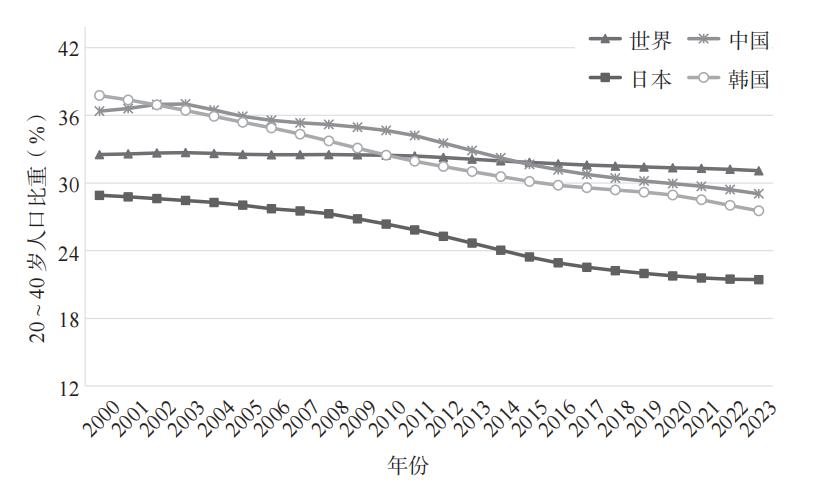
According to World Bank data, the total fertility rates for China, Japan, and South Korea in 2022 were 1.18, 1.26, and 0.78, respectively, while their aging rates in 2023 were 14.3% (15.3% according to China’s National Bureau of Statistics), 29.6%, and 18.3%. As a consequence of aging, the proportion of the core working-age population (20-40 years old) relative to the total population has rapidly decreased in China, Japan, and South Korea, dropping by 7.3, 7.5, and 10.2 percentage points from 2000 to 2023 (see Figure 1).
Fact 2: Automation and Technology Increase Income Inequality
When machines (robots) become a more economically rational choice for employers compared to human labor, it implies a shift in the balance of the labor market and labor relations, placing workers at a disadvantage in bargaining positions, leading to a decline in labor compensation relative to capital returns. Simultaneously, workers with different human capital endowments face varying market demands and returns, resulting in an expanding income gap among them.
Acemoglu and others observed that from the perspective of the relationship between capital and labor, automation and robotics tend to reduce the labor share of national income, suppress wage growth, and limit employment expansion. From the relationship between skilled and unskilled labor, the latter is often the primary target for replacement, which, while increasing the demand for skills, further exacerbates income disparities. This empirical fact holds significant policy implications for China.
During its rapid economic development, China has experienced notable fluctuations in income inequality. The income ratio between urban and rural residents (with rural residents as 1) and the Gini coefficient for residents increased from 2.24 and 0.31 in 1981 to peaks of 3.11 and 0.49 in 2009, before gradually decreasing to 2.45 and 0.47 in 2022.
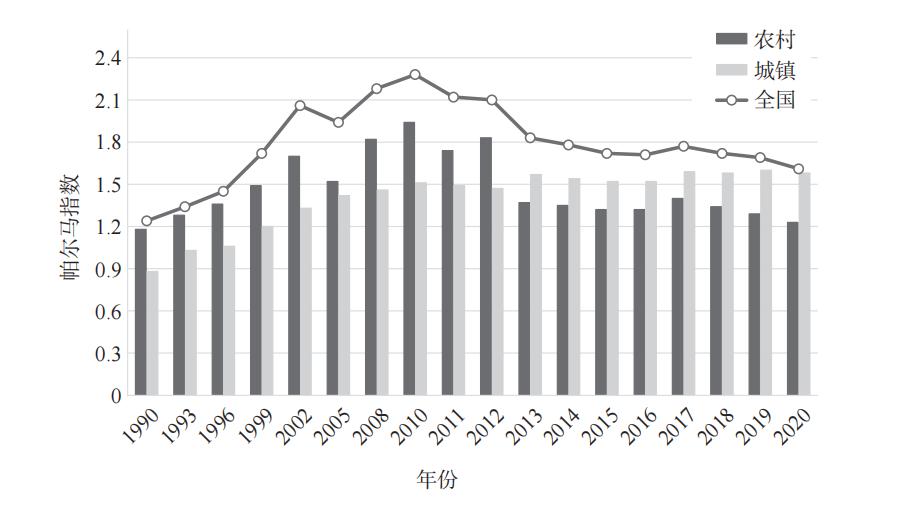
As shown in Figure 2, we use a different indicator from the Gini coefficient, the Palma index, which reflects income disparity among residents, to display the trend in income distribution in China. This index shows a trajectory that rises, reaches a turning point, and then declines, resembling the theoretical Kuznets inverted U-shaped curve.
Fact 3: AI Development Should Be Guided to Create Productive Jobs
Acemoglu and others found that the application of new technologies like AI presents opposing patterns of choice. If enterprises and society are guided towards automation as the primary goal, favoring the replacement of labor and reducing labor shares rather than focusing on job creation to narrow income gaps, it indicates market failure. The “correct” outcomes of technological change do not arise naturally but can be achieved through institutional arrangements.
From an economic perspective, the ongoing debate about how technological inventions and applications can benefit workers involves the general conclusion about market failure and the necessity of government intervention, and how this applies to the field of technological change. Researchers from multiple disciplines are actively engaged in discussing this issue, albeit with different terminologies, some arriving at alternative conclusions. For instance, scholars in the AI field may be most aware of the potential dangers of AI technology, thus raising the issue of aligning AI with human ethics. Meanwhile, some argue that the alignment issue itself may lead us into a logical dilemma: aligning with what kind of ethics from whom?
Before revisiting the alignment-related issues in subsequent sections, we first explore whether it is possible to avoid unnecessary employment shocks caused by AI within the framework of market failure.
For most economists, the incompatibility of incentives between micro and macro levels is a typical manifestation of market failure. On one hand, enterprises often respond rationally to labor shortages and rising wages through various means, including technological choices, product structure adjustments, and changes in management methods; this motivation to save labor costs is understandable. On the other hand, the government, from a macro perspective, aims to utilize human resources efficiently and stabilize and improve people’s livelihoods, hoping that corporate adjustments do not undermine employment.
The theory and experience regarding the relationship between markets and government indicate that alignment can be achieved between the different starting points of micro entities and macro regulators. In implementing employment-first policies and industrial policies, addressing market mechanism deficiencies and enhancing government provision of public goods to resolve incentive compatibility issues is an intention and practice of alignment. However, we still need a deeper understanding of AI’s employment impacts to truly update relevant policies in response to the changed circumstances.
Comments
Discussion is powered by Giscus (GitHub Discussions). Add
repo,repoID,category, andcategoryIDunder[params.comments.giscus]inhugo.tomlusing the values from the Giscus setup tool.